
Millage Reset

Benzie County’s Millage Reset
What You Need to Know
On August 4, 2026 Benzie County voters will decide on a millage reset for the County. Most people don't know that Benzie County's general operating millage has been quietly eroding for over 40 years. Under Michigan's Headlee Amendment, the county's millage rate is automatically reduced whenever property values rise faster than inflation — and it has happened almost every year since voters set the rate in 1982. What started at 5.29 mills is now 3.24 mills. The county hasn't spent its way into this situation. State law created it.
The result is a general fund that can no longer sustain the services we all depend on — road patrol, 911 dispatch, animal control, emergency management, economic development, and more. To make ends meet, the county has had to go back to voters repeatedly for small, separate millages for individual services. That's why your tax bill has so many line items. It's not by design. It's a workaround.
On August 4, Benzie County voters will have the opportunity to reset the general operating millage to 4.44 mills — still below the rate originally approved in 1982 — and consolidate several of those smaller millages into one. For a $200,000 home, the difference is about $79 a year, roughly $0.22 a day. This is not a new tax. It's a restoration.
The Chamber has formally endorsed a yes vote.
How the Headlee Rollback Works
For those who want to understand the mechanics more deeply, here is a plain-language summary of the Headlee Millage Reduction Fraction formula discussed during the presentation. A property tax calculator specific to this ballot measure is available at benzierenewal.org — enter your parcel number to estimate the impact on your property.
The formula:
Millage Reduction Fraction = (Current Year Taxable Value + Additions) ÷ (Previous Year Taxable Value + CPI Multiplier) × (adjustments for losses)
- CPI Multiplier — published annually by the state; the same for every county in Michigan
- Additions — primarily new construction; increases the fraction (less rollback)
- Losses — demolitions, exemptions, properties leaving the tax rolls; decreases the fraction (more rollback)
- The fraction can never exceed 1.0 — so this mechanism only reduces millage rates, never increases them
Why the rate has fallen so far:
After the 2008–2009 housing market crash, falling property values drove the fraction down dramatically. More recently, state laws exempting significant classes of property (manufacturing personal property exemptions, hardship exemptions, charitable property) have added to losses, pushing the fraction lower each year.
Resources
The County has established an informational website that includes a tax calculator, at benzierenewal.org.
A list of Benzie County polling places is available at mvic.sos.state.mi.us
Key Dates:
- Online voter registration deadline: July 14, 2026
- Absentee ballot request deadline (by mail): July 31, 2026
- Election Day polls open: August 4, 2026, 7:00 AM – 8:00 PM
Request a yard sign: Email Jen Kruch.
Download a copy of the presentation from the Community Meeting: Click here.
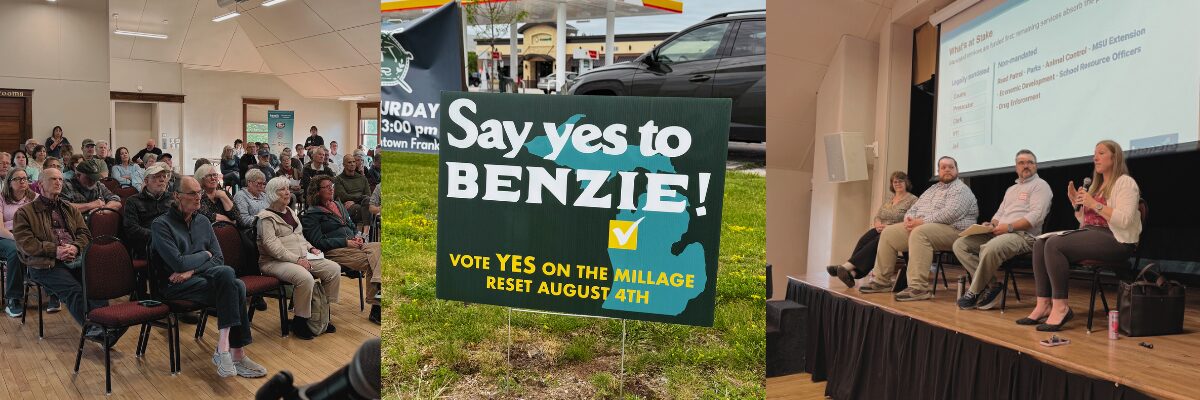
Highlights from the June 16, 2026 Community Meeting
Over 90 residents came out to Mills Community House on June 16 to learn about the millage reset. Panelists from the County’s Tax Advisory Committee answered questions, and the transcript from the meeting is below.
Note: This is an edited transcript of a public meeting, cleaned from an audio recording. If you see an inaccuracy, please reach out to Jon Willow.
Welcome and Introduction
Presented by Jon Willow, Executive Director, Benzie Area Chamber of Commerce
Thank you all for coming out on such a beautiful evening. My name is Jon Willow, and I am the newly minted Executive Director of the Benzie Area Chamber of Commerce. I've only been in my role about six months. For those of you who follow such things, you may know that our Chamber was dormant for just over a year. During that time, the county and the community got together and decided we were going to restart the Chamber - and make the most of it.
We have an excellent civic chamber in the City of Frankfort. I want to welcome and thank Brenna Nugent for coming tonight. She's doing an excellent job! The Benzie Area Chamber has actually moved into the Frankfort Chamber's offices so we can collaborate even more.
We're here tonight to talk about the Headlee Millage Reset. It's a complicated issue and can feel like a divisive one. But the best decisions are made when we fully understand what's at stake. Tonight, I want to walk you through this because it affects every business and family in the county. I want everyone to leave with a clear picture of what's on the ballot on August 4th.
The Benzie Area Chamber of Commerce believes that a yes vote is the right call for Benzie County. We understand that may not be your position. As an organization, we advocate for what we believe is in the best economic interest of the county — and we respect that you may see it differently. We have community leaders here tonight to explain the millage reset, and then we will open it up for your questions.
Tonight's Panel
Our panel is comprised of members of the Benzie County Tax Limitation Advisory Committee, established per state statute to study the county's declining revenue and provide a set of recommendations to the Board of Commissioners.
- Kelly Long — County Treasurer; custodian of the county's tax rolls
- Katie Zeits — County Administrator; designated by the Board of Commissioners
- Jason Barnard — Benzonia Township Supervisor
- Michael Beach — County Equalization Director; responsible for determining tax rates in coordination with the Register of Deeds and Treasurer
The Ballot Language
The August 4th ballot reads:
"Shall separate tax limitations be established for a 2-year period, until altered by the voters of the county, for the County of Benzie and townships and intermediate school district within the county, the aggregate of which shall not exceed 5.8327 mills?"
Panel Presentation
What Is a Mill?
Kelly Long, County Treasurer
A mill is $1 for every $1,000 of taxable value. So if you have $100,000 in taxable value, you're looking at $100 per mill per year.
Your taxes are based on your taxable value — not the purchase price of your home, and not your full assessed value. Your taxable value is based on your State Equalized Value (SEV), which is 50% of your property's true market value. So if you purchase a home for $250,000, the assessor may value it at $125,000 SEV, giving you a $100,000 taxable value in the first year (after any applicable exemptions).
The current general operating millage this year has rolled back to 3.1874 mills. For every $100,000 in taxable value, that's approximately $318 per year.
How the Headlee Rollback Works
Michael Beach, County Equalization Director
In 1978, Michigan voters passed Proposal E, which adopted modifications to the Michigan Constitution known as the Headlee Amendment. It introduced a number of changes to property tax law, including:
- Capping state revenue
- Prohibiting unfunded mandates
- Requiring voter approval for new or increased taxes
- Creating the millage reduction fraction
In 1982, the Board of Commissioners asked residents to approve a proposal establishing fixed millage rates for the county, townships, and intermediate school district. Those rates were set at:
- 5.29 mills — County
- 1.121 mills — Townships
- 0.27 mills — Intermediate School District (ISD)
This proposal was drafted with indefinite language — meaning it was not set to expire. This is why it has been so long since Benzie County residents have voted on this matter. Many counties use expiring language that brings voters back on a regular cycle; our 1982 ballot did not.
The Millage Reduction Fraction
The millage reduction fraction is a multiplier — a decimal number between 0 and 1 — that is applied to the previous year's millage rate to determine the current year's rate. Because it can never exceed 1, this process only ever reduces the millage; it never increases it.
The formula compares the current year's taxable value (above the division line) to the previous year's taxable value (below the division line), with a multiplier for general inflation published annually by the state based on the Consumer Price Index. This multiplier is the same for every county in Michigan.
Additions and Losses
- Additions — primarily new construction — move the fraction upward toward 1. More new construction means less rollback that year.
- Losses — primarily from demolitions, business closures, or properties becoming tax-exempt (hardship exemptions, charitable organizations, government-owned properties, eligible manufacturing personal property) — move the fraction downward, further reducing the millage.
Key takeaways:
- The system is designed for a growing economy. When general inflation outpaces property value growth (as happened after the 2008–2009 market crash), it pushes the multiplier downward, reducing the levy further.
- When the state passes laws exempting significant numbers of properties, it dramatically affects local government revenue — both through increased administrative burden and through erosion of the tax base.
Where We Are Now
Katie Zeits, County Administrator
What's before you on the August 4th ballot is a reset of the general operating millage.
Since the millage was established in 1982, it has rolled back nearly every year. We are now operating at 3.18 mills — down from the original 5.29 mills. That ongoing reduction has caused some services to disappear from Benzie County over time. Planning and zoning, for example, was eliminated as a county department — we now contract for building code services. There was also a period when we did not have 24-hour road patrol, also due to funding constraints.
The general operating millage funds the general fund, which covers:
- Sheriff's office and road patrol
- Emergency management
- Clerk's office
- Courts and Prosecutor's office
- Administration
- Parks and recreation
- MSU Extension programming, including summer soccer program and 4-H
Some of these services are mandated by the state — courts, the Prosecutor, the Clerk, the Treasurer. Others are quality-of-life services that we are not legally required to be provided but that our community values deeply.
When funding gets tight, we are legally required to fund mandated services first. That means quality-of-life services are the first to go. Without the millage reset, we would need to seriously examine which of those services we can no longer afford.
Impact at the Township Level
Jason Barnard, Benzonia Township Supervisor
Townships also fall under this millage structure. Benzonia Township was originally approved at 1.121 mills in 1982. We are currently operating at approximately .74 mills — roughly two-thirds of what was originally approved. Every township is in a similar situation, though the exact rollback differs by township based on each community's specific history of new construction, demolitions, and exemptions.
The services that townships provide — fire protection, cemeteries, planning and zoning, elections — could all be affected. Benzonia Township has its own fire department supported by a separate operational millage, so our fire services are not directly at risk here. But other townships without dedicated fire millages may face greater exposure.
I want to emphasize: 1982 to 2026 is 44 years. The inflation over that period is staggering. There are townships in this county that are struggling significantly more than Benzonia, and this reset would help every one of them.
A clarification on township rates: In 1982, all townships were set at the same 1.121 mills. Today, they are all different — because the millage reduction fraction operates township by township, based on each community's unique development and demolition patterns. If you are not in Benzonia Township, your rate will differ from .74 mills.
Audience Q&A
Questions were submitted in writing. Similar questions were grouped. All questions submitted tonight will be answered — any not addressed in the meeting will receive a direct email response within the week, provided an email address was included.
Q: Will you please provide a list of all questions submitted as part of this public process? (Matt Rush, Lake Township)
A: Absolutely. There is no way to do a video recording or live stream tonight with the AV equipment available to us, but the county team has set up an audio recording of this meeting. At minimum, I have all questions in writing and will post them on the Benzie Chamber website. If we obtain any recording, we will post that as well. Full transparency is the goal.
Q: Why is the ISD millage included in this one ballot request? Will this increase the ISD's total millage from 2.88 to 3.06 mills? (Kris Burks, Frankfort)
A: The ISD is included because of how Michigan property tax law is structured. In 1982, public schools were part of the original millage allocation. Proposal A in 1993 pulled the public school system out of this structure, but the ISD remained within these allocation methods — that's why it's still listed here.
However — and this is important — the ISD rate stays at its current rollback rate of approximately 0.18 mills. Formally, Kalkaska was designated as the seat of that ISD district when it was created. For the ISD's millage rate to change, Kalkaska would have to call for that reset. Since Kalkaska is not initiating this action, the ISD portion stays at status quo. It is listed in the ballot language for legal completeness, but it will not increase.
Q: Can you expand on how elections and planning and zoning would be affected by the millage outcome? (Jana Goldman, Homestead Chair, Honor Planning Commission)
A: Elections and planning and zoning are both funded from the general fund. I'm not aware of any township that has its own dedicated millage for either function.
Elections are a mandated service — townships are required by law to conduct elections. So election functions would not disappear, but funding them would come at the cost of other services. Money that currently supports quality-of-life services would be redirected to meet that mandate.
Planning and zoning is not mandated in the same way. If zoning exists on the books, enforcement still has to happen — but the practical reality is: if planning commissioners are paid per diem, will they show up if there's no money to pay them? Will townships have funds to update their master plans, which are often required to qualify for grants tied to planning and zoning improvements? That's where the pinch comes.
Q: Have actual budget dollars kept pace with inflation, or are we adding services and costs? (Betsy Alles, Frankfort)
A: We have actually removed services over time. Planning and zoning was eliminated as a county department. Building inspection is now contracted out. We have also pursued special millages to fund specific services separately from the general fund — things like the School Resource Officer, drug enforcement, and animal control — rather than absorbing them into general operations. That's how we've managed with declining general fund revenue.
Q: Will the PowerPoint presentation be made available after the meeting? (Marianne Samper
A: Yes, absolutely. It will be posted on the Benzie Chamber website and distributed through the Benzie Chamber newsletter. If you haven't subscribed, you can sign up at benzie.org.
Q: Doesn't part of this ballot proposal consolidate some special millages into the general fund, rather than keeping them as voter-approved standalone items? Does that remove voter control over how those dollars are spent? (Follow-up question, submitted)
A: Yes — part of what is reflected in the slightly higher millage ask is the consolidation of three current special millages into the general fund:
- School Resource Officer
- Drug Enforcement Officer (TNT)
- Animal Control and Shelter
Right now, because these are separate special millages, the money can only be used for those specific purposes. If one fund has a surplus and another has a shortfall, I cannot move dollars between them. That rigidity means I sometimes have to cut a service even when money exists elsewhere that could theoretically cover it.
Folding them into the general fund gives flexibility to allocate dollars where they're most needed.
As for voter control — in a way, yes, consolidating removes one layer of direct voter approval for those specific line items. But the county's full budgeting process is public. We have multiple budget hearings every year, and the Board of Commissioners does listen. The way to maintain community influence over how these dollars are spent is to show up at those meetings and hold the board accountable. That process remains fully open.
Q: Instead of asking for a millage increase, why not look for efficiencies — consolidating townships, modernizing business processes, etc.? Did you just decide to "line item" the public instead? (Doug Hatfield, Gilmore)
A I don't have the authority to consolidate townships — that's a process that begins at the township level and would escalate to the state. If township consolidation is something you want to pursue, the place to start is your township board.
Are we constantly trying to modernize and find efficiencies? Yes. When I came to Benzie County five years ago, I was pushing constantly to do things differently — put it online, cross-train staff, share services. We still do that.
Some concrete examples of what we've already done:
- Closed the defined benefit pension plan for new hires. New employees go into a defined contribution plan with a required 6% employee contribution. No immediate savings, but significant long-term savings.
- Changed health insurance from a fully-loaded plan to a high-deductible plan after facing a 42% premium increase. We switched carriers and restructured. It was hard, but we couldn't absorb that increase.
- Re-implemented 24-hour road patrol by working collaboratively with the Sheriff's office on a phased plan that didn't require immediate additional dollars.
- Used COVID-era federal funds strategically, investing in reserves and long-term modernization rather than one-time spending. We took $3.4–5 million [?] and built it to a $16 million reserve position [?], then used the freed-up operating dollars to enhance services.
Cost increases we simply cannot avoid:
- Liability insurance went from $152,000/year to $245,000/year in five years.
- Government software (BSA suite) went from roughly $20,000/year to over $90,000/year — and there is effectively no alternative for the functions it performs. I put that question out to all 83 Michigan counties. There's nothing else.
- Police vehicles: from ~$55,000 to over $70,000 per fully equipped car.
- Ambulances: from ~$180,000 to $238,000.
- Healthcare software, Microsoft licensing, and other tools have shifted from annual purchases to monthly subscriptions.
We are being outpaced by the market. We look constantly for ways to do more with less. But there is a floor.
Q: Is Benzie County alone in not having reset its millage until now? (Paul Danes, Frankfort)
A: No, but we are nearly alone. There are only two or three Michigan counties besides Benzie that have not done some form of override or reset. Every other county in the state has acted. That's why this has become so urgent — Benzie County has simply made do with less for 44 years, and there is nowhere left to absorb additional reductions.
Q: What percent or dollar amount of the anticipated revenue increase will be dedicated to attracting and retaining staff? (Annie Noah)
A: The Board of Commissioners has set a goal of bringing county wages to the mid-level of comparable counties — not the highest, not the lowest, but competitive. Our comparable counties are determined not just by population, but by taxable value and other factors set through a collective bargaining arbitration process. We will never compete with Grand Traverse or Leelanau County on wages, but we do compete with them in the labor market — which is why organizational culture matters so much.
We have not allocated a specific portion of any potential millage increase to wages. What we have done is work to keep wages in the mid-range, make incremental increases where possible, and invest in culture and benefits to attract people who want to be here. If a specific position is chronically unfillable and we identify wages as the cause, we address it individually against comparable county benchmarks.
Q: How much does it cost per prisoner? Can Benzie County farm out prisoners at a lower cost? (Kay Bond)
A: Benzie County has a 48-bed jail. Typically, only 30–40% of those beds hold Benzie County inmates — because court reforms and jail reform have significantly reduced local inmate populations across Michigan. Rather than leaving beds empty, we partner with Grand Traverse County to house their overflow inmates.
Grand Traverse County has a well-publicized overcrowding problem (Project Alpha). They bring their inmates to us and pay us:
- A daily room-and-board rate (we recover our costs and make a modest amount)
- Separately for all inmate medical costs
That arrangement brings in approximately $200,000–$230,000 per year in revenue that offsets the cost of running the jail.
One important note: the Michigan Department of Corrections (MDOC) sets minimum staffing requirements for jails, and those requirements don't change whether the jail is full or empty. We have to pay for a certain number of corrections officers regardless. Filling those beds with Grand Traverse and neighboring inmates is how we make that fixed cost work for us financially.
Q: Individuals are facing high costs in the current economic environment and difficult choices about food and energy. Where does the county expect people on fixed incomes to find more dollars to pay higher taxes? (Becky Bagnall)
A: This is something I think about personally — my elderly father lives with me on a fixed income, and I'm glad my family can support him. I understand this is a genuine hardship for many residents of Benzie County.
Two things worth knowing:
- Benzie County has a strong track record of working with residents to keep them in their homes. We very rarely foreclose on properties. Last year, there were no homes on the foreclosure list because the Treasurer's office works with residents — even those who can only pay a few dollars a week toward their taxes — to find arrangements that keep people housed.
- There is a hardship exemption on property taxes available to qualifying residents. If you or someone you know may be eligible, please contact the Treasurer's office.
The honest answer is that it's not an easy tradeoff. But the quality-of-life services that residents of Benzie County rely on also have real costs — and those services disproportionately support the most vulnerable members of our community.
Q: Where is the revenue from the lottery fund for schools? Can we consolidate Frankfort and Benzie schools? (Maureen Hatfield, Gilmore)
A: School consolidation and lottery fund distribution are both state-level decisions — they are not within the authority of the county or the Chamber. School districts have some of the most powerful lobbying representation at the state level. If this is something you want to push for, it requires going to Lansing. It's not something we can control locally.
Q: Would the county consider publishing performance metrics after the millage passes — regular reporting on what the dollars accomplished? (Matt Rush, Lake Township — second question)
A: The county already publishes a "Budget at a Glance" document each year that provides a year-over-year snapshot with breakdowns by department and function. Our annual audit is also public. However, we no longer produce a dashboard report following changes at the state level.
If there are specific, identifiable metrics the community wants tracked and reported — something meaningful that we could measure consistently — I would be open to working with community members to build that. If someone has the skills to help design a format, I'd welcome the collaboration. That seems like a reasonable lift if we can do it together.
(Note: Matt Rush appeared willing to discuss this further. The County Administrator suggested following up directly.)
Q: What recourse do taxpayers have if the millage destroys property values by making taxes so high that no one wants to move here? (Doug Hatfield — submitted with a comparison to New York and California)
A: If property values declined significantly, the Headlee formula would actually reduce the millage — the rollback mechanism is designed to respond to declining valuations. A dramatic drop in property values would require sustained, prolonged declining sales across an extended period. In any case, voters would have the opportunity to vote on this measure again before any such scenario could play out. The 2-year term is specifically designed for this kind of accountability.
For context: property taxes in Benzie County would remain well below those in most comparable Michigan markets even after the reset, and far below New York or California.
Q: What business development alternatives to tourism does the county have in mind? (David Schleisman — noted as more of a Chamber question)
A The county has been partnering actively with the Chamber in a public-private partnership to think more strategically about economic development. We are also working to bring the townships together around coordinated zoning and planning to make it easier for businesses to get started and grow in the county.
One specific project: we supported the Benzie Conservation District in what they're calling the Zone Project — creating GIS map layers that aggregate zoning data from across the county into one place. Prospective businesses would be able to go to a single resource to find out what's zoned for what, who the contact is, and what the development parameters are. That kind of infrastructure matters for business attraction.
(Note: David Schleisman had additional questions for the Chamber specifically. Jon Willow offered to sit down with him directly and left a business card.)
Q: Who is on the Tax Limitation Advisory Committee, and who appoints them? (Janet Gould, Joyfield)
A: A note on terminology first: there are two different boards under Michigan statute — the Tax Limitation Advisory Committee and the Tax Allocation Board. These are very different. The Tax Limitation Advisory Committee is what we have been discussing tonight.
The Tax Limitation Advisory Committee was established by resolution of the Board of Commissioners. Its members are:
| Member | Appointment |
| County Treasurer | By statute (ex officio) |
| Finance Chair or designee | Board of Commissioners |
| Probate Judge appointee | Mandy Gray-Rineer |
| Township Supervisor representative | Chosen by township supervisors; Jason Barnard served |
| ISD/Schools representative | Chosen by the ISD; Matt Olsen served |
| Citizen at large (not connected to local government) | Randy Rice, Joyfield Township; appointed by Board of Commissioners |
Q: What is your estimate for taxable value increase, and how much will county revenue increase if the millage passes? (Kipton Moravec, Benzonia)
A: Taxable value increases each year by the state's inflation adjustment, based on the Consumer Price Index. Unless you've recently purchased a home or gone through an uncapping event, that CPI-based figure drives the change in your taxable value each year.
Based on today's taxable values, the millage reset is estimated to bring in approximately $1.8 million in additional annual revenue at the county level. (Townships would see their own proportional increases.)
An important clarification: the millage reset establishes a ceiling, not a floor. Every taxing authority in Michigan has the option to levy less than the maximum allowed. The Board of Commissioners adopts a levy each budget season (the L4029). Over the last five years, the county has consistently levied only what it needed — not the maximum. For example, the School Resource Officer millage, drug enforcement millage, and ARPA-funded programs were all levied at reduced rates when circumstances allowed.
Would the county levy the full $1.8 million increase from day one? Likely not all of it. The county has a five-year capital plan, and they set the levy based on identified needs, not on what they're allowed to take.
The general fund currently stands at approximately $9.5 million.
Q: How much money did 1.121 mills bring in for townships in 1982, and how does .74 mills compare in today's dollars? (Stephen Brown)
A: We don't have those exact 1982 figures at hand tonight, but we can pull them. It would be a very useful comparison — especially to understand what services were funded at that time versus now, and how the composition of those services has changed (for example, was animal control or jail included in that original allocation?).
To give a concrete present-day example: a home with $200,000 in taxable value in Benzonia Township, levied at the full 1.121 mills, would pay approximately $224.20/year to the township. At our current .74 mills, that same home pays approximately $148/year.
(The County Administrator committed to researching the 1982 figures and sharing them.)
Q: Where is the revenue from legalized marijuana? Wasn't that supposed to add to our revenue base? (Maureen Hatfield, Weldon)
A: It has. Benzie County receives approximately $217,000–$234,000 per year from the statewide marijuana excise tax distribution. It does vary year to year.
Those dollars are in the general fund and can be used flexibly. One of the most impactful uses has been re-establishing 24-hour road patrol. To clarify what that means: without 24-hour patrol, Benzie County had a Sheriff and Undersheriff, but after hours, residents were routed to the State Police. The State Police had a detachment in Honor [?] that was later consolidated and removed from Benzie County — leaving a meaningful coverage gap.
We were able to bring back 24-hour patrol with some support from marijuana revenue and other efficiencies. We also worked with the State Police to establish a resident trooper detachment within the Sheriff's office, so Benzie County now has both 24-hour county road patrol and two resident state troopers. That's a significant public safety improvement.
Closing Statement
Jon Willow, Benzie Area Chamber of Commerce
The Benzie Area Chamber of Commerce acknowledges that tax reform and fiscal reform may be needed in Benzie County. We live in a state where property taxes are local government's primary funding source. To change that, we must all work with our township and county officials — understanding the tax code, generating new revenue, and making informed recommendations, both formally and at the ballot box.
We do not believe that simply eliminating the county's operating budget with no replacement plan is a logical or prudent option.
The proposed levy is still almost a full mill less than what voters approved in 1982. It eliminates three special millages, stabilizes county operations, and safeguards services our community values.
What should not get lost here: while most Michigan counties reset their millages every two to four years, Benzie County has been making do with less and less for 44 years, relying on special millages to patch gaps. We've kicked the can down the road as far as it will go.
On August 4th, we have a chance to make a considered, purposeful decision — to stop the erosion and move forward without derailing our community.
The Benzie Area Chamber of Commerce recommends a YES vote on August 4th.
Thank you all for being here tonight.